Every professional eventually hits a crossroad where hard work alone stops translating into vertical movement. You master the tools, you clear your tickets on time, and your technical execution is flawless—yet, during the annual review, the management role goes to someone else. This brings us to the ultimate corporate debate: hard skills vs soft skills for promotion.
While technical competency gets you through the door, it is your people management and leadership influence that move you up the ladder. If you want to unlock the next phase of your career, understanding the difference between hard and soft skills for career growth is no longer optional—it is a survival strategy.
Let’s break down the mechanics of technical skills vs soft skills career advancement, explore why the corporate landscape is shifting, and look at how you can bridge the skills gap to secure your next internal promotion.
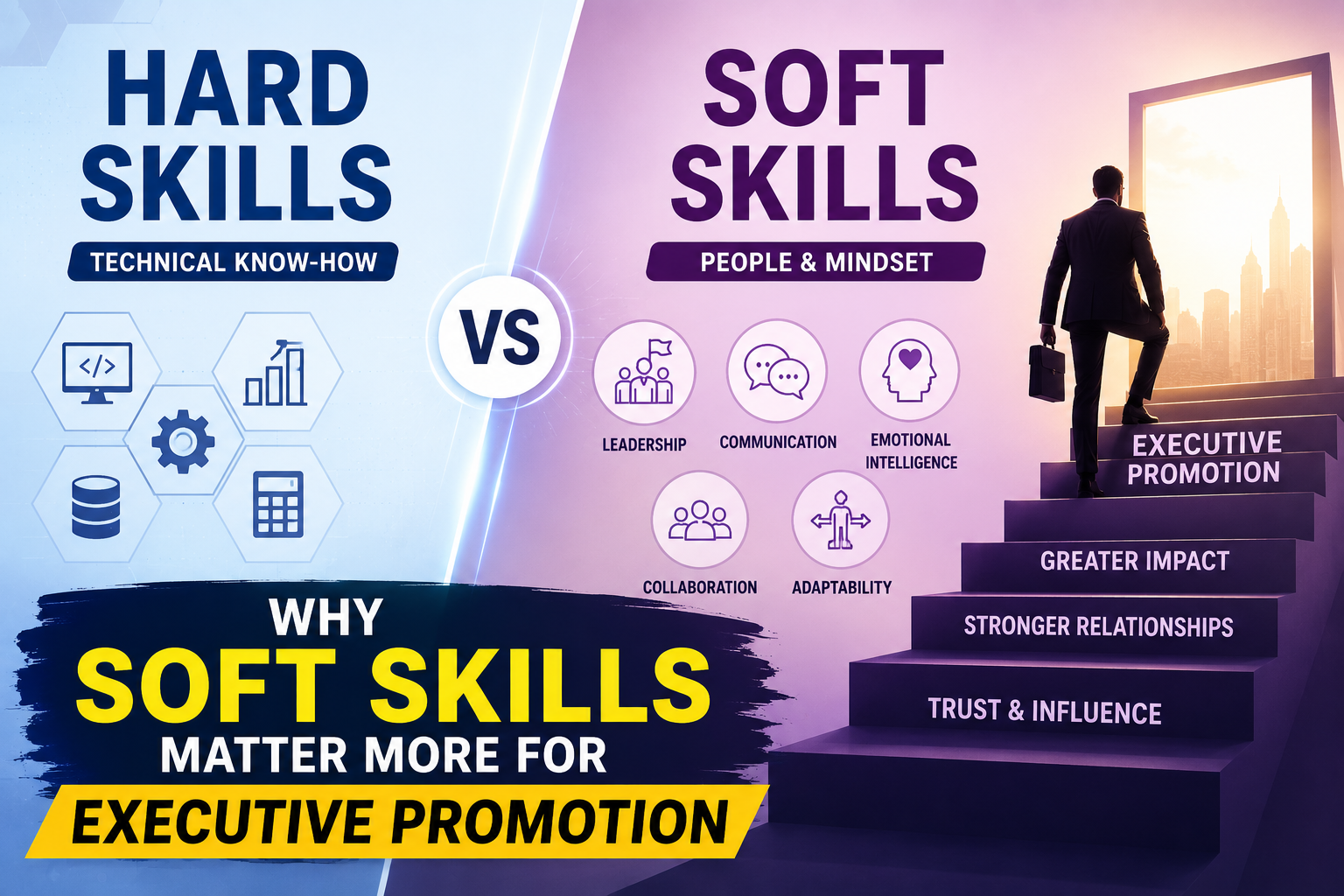
Hard Skills vs Soft Skills in the Workplace: The Core Differences
To understand what matters more for promotion hard or soft skills, we first need to define how these two powerhouses operate inside the modern corporate ecosystem.
-
Hard Skills are quantifiable, teachable abilities that can be measured through tests, certifications, or direct output. Examples include coding languages, financial forecasting, SEO content writing, data analysis, and machine learning.
-
Soft Skills, on the other hand, relate to your workplace behavior and leadership influence. They include emotional intelligence, active listening, conflict resolution, time management, and adaptability.
While hard skills are job-specific, soft skills are transferable skills for leadership that apply across every industry and role.
Technical Competency vs People Management: The Promotion Paradox
In the early stages of a career, your value is tied to your individual contribution. If you are an engineer, you write code. If you are an accountant, you balance books. However, a major shift occurs when you move from an individual contributor to a managerial role.
The chart below illustrates how the required balance shifts as you move higher up the corporate ladder:
| Organizational Level | Hard Skills (Technical Competency) | Soft Skills (People Management) | Primary Focus |
| Entry Level | 80% | 20% | Task execution, learning tools, speed |
| Mid-Management | 50% | 50% | Team coordination, project delivery |
| Executive Level | 10% | 90% | Strategy, alignment, organizational culture |
This shift explains why technical experts fail as managers due to soft skills. A brilliant data analyst might know how to build predictive models, but if they lack interpersonal skills at workplace settings, they won’t be able to motivate a team, manage client expectations, or resolve conflicts between team members.
Why Soft Skills Are Essential for Career Progression
Many professionals ask: can hard skills alone get you promoted? The short answer is yes, but only up to a certain point. Hard skills can earn you a title like “Senior Specialist” or “Principal Engineer,” but they rarely grant you access to the boardroom. Here is why soft skills are essential for career progression:
The Power of Leadership Influence
Management is not about doing the work; it’s about getting work done through others. This requires moving away from pure analytical thinking and emotional intelligence implementation. You need to read the room, understand employee burnout, and inspire people.
Stakeholder Management and Communication
As you rise, you represent your team to higher executives and external clients. If you cannot translate complex technical data into simple, business-oriented language, executives will view you as a technician rather than a leader.
Navigation of Corporate Politics
Promotions are rarely based on metrics alone; they are driven by visibility. How you handle feedback, how you react under pressure, and how you collaborate across departments determine your internal reputation.
Top Soft Skills Required for Executive Level Promotion
If you are aiming for a senior leadership or executive role, you must consciously nurture specific traits. Executives look for a precise soft skills checklist for career growth when evaluating candidates for promotion:
-
Emotional Intelligence (EQ): The ability to identify, understand, and manage your own emotions, as well as those of your team. High EQ prevents impulsive reactions during crises.
-
Strategic Communication: Knowing when to speak, how to pitch an idea, and how to practice active listening to build trust.
-
Conflict Resolution: The capacity to mediate disagreements between cross-functional teams without letting personal biases interfere.
-
Adaptability and Decision-Making: Leading a team through market shifts, company restructuring, or technological changes with confidence.
How to Demonstrate Soft Skills for Promotion
One of the biggest challenges with soft skills is that they are difficult to quantify. You can show a certificate for a hard skill, but how do you prove you have high emotional intelligence?
Here is how to demonstrate soft skills for promotion so that upper management takes notice:
Focus on Measurable Soft Skills for Performance Reviews
Don’t just state that you are a “good communicator.” Prove it with data during your annual evaluation.
-
Instead of: “I managed the project well.”
-
Use: “I coordinated cross-functional communication between the design and development teams, which reduced project delivery delays by 15%.”
Actively Seek Cross-Functional Roles
Volunteer for initiatives that require collaborating with other departments. This highlights your interpersonal skills at workplace environments outside your immediate comfort zone and increases your internal visibility.
Optimize Your Internal Documentation
When applying for a new internal role, know how to highlight soft skills on resume for internal promotion. Dedicate a section to leadership achievements, such as mentoring junior staff, leading agile meetings, or restructuring team workflows.
Balancing Upskilling vs Reskilling for Corporate Advancement
To future-proof your career, you must constantly balance upskilling vs reskilling for corporate advancement.
-
Upskilling involves deepening your existing technical expertise (e.g., a senior marketer learning advanced programmatic advertising).
-
Reskilling involves learning entirely new competencies to adapt to changing roles—which frequently means addressing the skills gap for leadership promotion.
If your technical capability is at an all-time high but your career growth has plateaued, it is time to halt technical upskilling temporarily. Redirect that energy toward leadership training, executive presence coaching, and public speaking.
Key Takeaway: Hard skills are what you know; soft skills are how you act. To secure a promotion, your technical competency must serve as the foundation, while your people skills act as the elevator.
Frequently Asked Questions
What matters more for promotion: hard or soft skills?
For entry-level to senior specialist roles, hard skills matter more. However, for managerial, directorial, and executive promotions, soft skills take priority. A balance of both is ideal, but people management skills become the ultimate deciding factor at higher corporate tiers.
Can hard skills alone get you promoted to management?
Rarely. While exceptional hard skills can make you a valuable subject matter expert, moving into management requires delegating tasks, resolving conflicts, and guiding strategy. Without strong soft skills, technical experts often struggle to lead teams effectively.
How do I identify my skills gap for leadership promotion?
Review your past performance feedback, ask for honest input from your current manager, or look at the job descriptions of the roles above you. If your feedback consistently mentions “needs to improve collaboration” or “needs bigger-picture thinking,” your gap lies in your soft skills.
How can I include soft skills on my resume for an internal promotion?
Instead of simply listing buzzwords like “team player” or “leader,” weave these skills into your bullet points using the STAR method (Situation, Task, Action, Result). Show the direct impact of your communication, mentorship, or problem-solving skills on business metrics.